The 2026 Sovereign Logistics Audit: Global Entry & Identity
Navigating the Biometric Pivot and the High-Friction Reality of Modern Boarding.

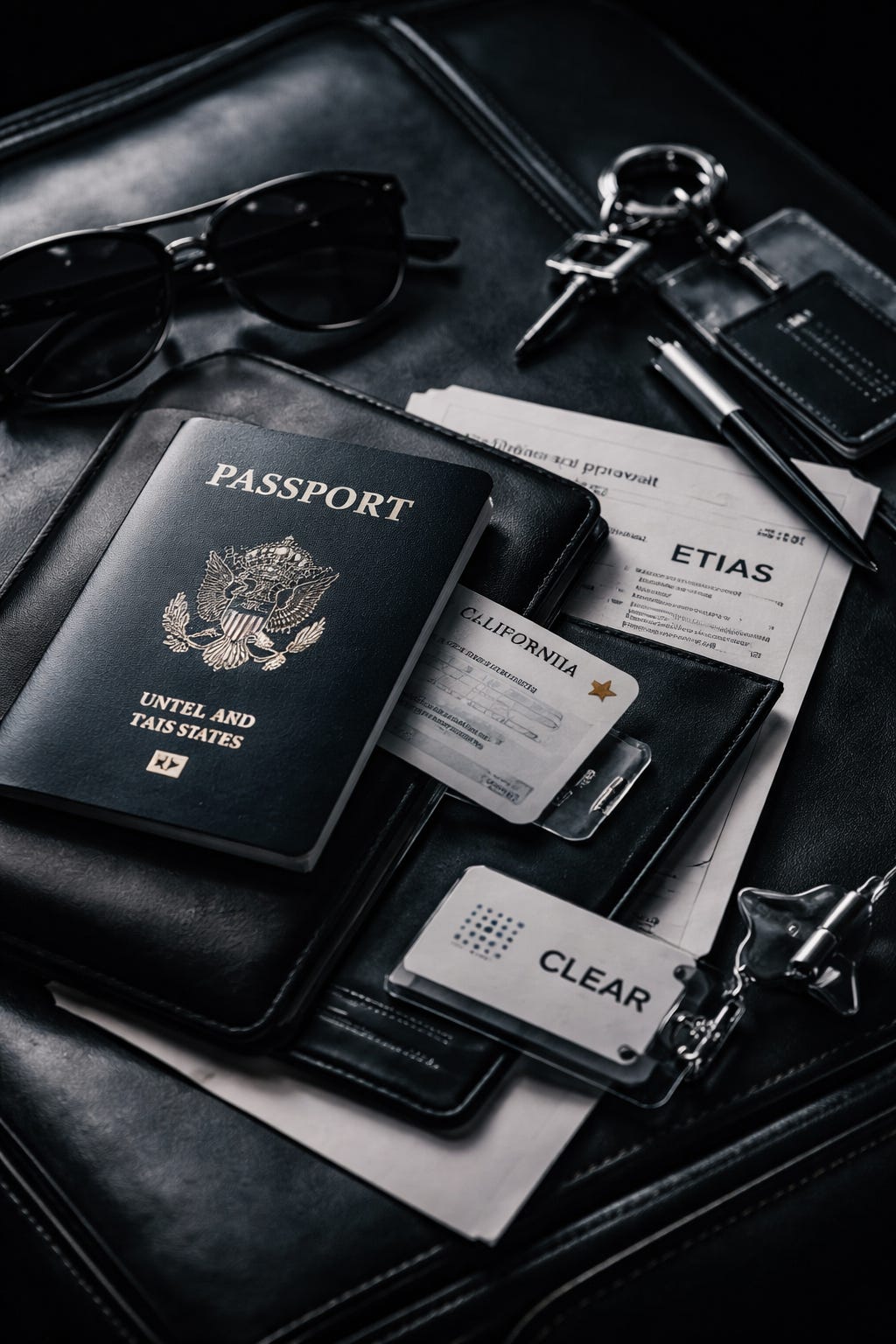
photo created with AI assistance for The Earth & Flame
Travel has not become more complicated. It has become more exact. There is a quiet shift happening in travel that has nothing to do with destinations or trends. It sits in the background, in systems most travellers only notice when something goes wrong. Licences that once worked no longer do. Borders no longer rely on stamps. Private terminals, for all their ease, still sit within the same global framework. The experience of travel may still feel fluid. The structure behind it is not.
1. US Domestic Travel Real ID
For domestic travel within the United States, identification now follows a stricter standard. A REAL ID is required to board commercial flights, unless you are travelling with a passport or another accepted form of identification. At a glance, it is simple to check. A small star in the corner of your licence indicates compliance. Without it, the licence does not meet the requirement. It is an easy detail to overlook and an inconvenient one to discover in a queue.
For those who arrive without acceptable identification, there is now a secondary pathway through the TSA. For a $45 fee, identity may be verified through an additional screening process. It can be arranged ahead of time or handled at the airport. It is not designed as a replacement, but as a contingency. The process takes time and, depending on the circumstances, may not resolve the situation in time for departure. For that reason, it is best treated as a safety net rather than something to rely on.
There is a quiet simplicity in carrying a passport, even for domestic travel. It removes the question entirely. Where licences and compliance can introduce uncertainty, a passport offers a consistent point of reference across systems, airports and countries. It is less about necessity and more about ease.
Private Aviation
Flying private changes the rhythm of travel. Through an FBO such as Signature Aviation or Atlantic Aviation, the experience becomes quieter, more direct, more contained. There are no queues, no crowded gates, no sense of urgency imposed by the terminal itself. What remains is the structure beneath it. Identification is still required. Passenger details are still recorded. Security still exists, even when it is less visible. Semi private services such as Aero and JSX follow similar principles, with a softer edge but the same underlying requirements. Private aviation refines the experience. It does not remove the system.
US Domestic: REAL ID & Emergency Verification
For the $45 emergency bypass (TSA ConfirmID) and general compliance audits.
Official TSA Identity Verification: tsa.gov/travel/security-screening/identification
DHS REAL ID Central: dhs.gov/real-id
2. CLEAR
Services such as CLEAR are often described as a way to move through the airport more quickly. That is true, but only in a very specific part of the journey. CLEAR allows you to verify your identity using biometrics, typically fingerprints or an iris scan, and move to the front of the security queue. It sits alongside TSA PreCheck rather than replacing it. What it does not do is replace the requirement for valid identification.
If you are flying domestically, you still need a REAL ID compliant licence or an accepted alternative. CLEAR can confirm who you are within its own system, but it does not override federal identification requirements. In practical terms, it speeds up the process once you are eligible to travel. It does not make you eligible.
It is also limited to participating airports and has no role in international border control. It does not apply to systems such as EES, ETIAS or UK ETA, nor does it change how you are processed when entering another country.
For private aviation, its relevance is even narrower. Most FBO environments do not use CLEAR, as identity is handled directly by the operator and, where required, by border authorities.
3. Entry/Exit System
Across the European Union, border control is moving away from stamps and towards biometric verification. The Entry Exit System (EES) introduces a digital record of arrival and departure, supported by facial imaging and, for most travellers, fingerprint data. For children under 12, fingerprints are not taken. Facial images still are. The first entry requires registration. Subsequent entries become quicker, guided by those stored identifiers. It is designed to feel seamless once in place, but participation is required. Without it, entry is not granted.
Data and Presence
The information collected through this system is retained for a defined period and managed within European data protection frameworks. There are formal routes to request access or removal, though for most travellers the system remains something they move through rather than interact with. It is simply part of crossing a border now.
4. European Travel Information & Authorisation System
Alongside biometric entry, travel into much of Europe now begins before departure. Through ETIAS, travellers from visa exempt countries are required to obtain authorisation in advance. It is a digital process, linked to your passport and completed prior to travel. Approval is generally quick, but it is necessary. Without it, the journey may not begin.
European Union: EES & ETIAS
These are the primary portals for the biometric and pre-travel screening protocols.
Official EU Travel Europe Portal: travel-europe.europa.eu
EES (Entry/Exit System) Info: travel-europe.europa.eu/ees
ETIAS (Pre-Travel Authorisation): travel-europe.europa.eu/etias
Data Protection (Biometric Purge): edpb.europa.eu (This lists the National Data Protection Authorities for each EU country to request data deletion).
5. The UK Electronic Travel Authorisation
The United Kingdom has introduced its own system through the UK ETA. It mirrors ETIAS in structure, requiring advance approval linked to your passport. What matters is that it operates independently. Travel to Europe does not cover entry into the United Kingdom. Each requires its own preparation.
Private Aviation Across Borders
When travelling internationally by private aircraft, the experience remains refined, but the process does not change. Arrival through a private terminal may mean being met directly by border officials or moving through a quieter space, but the same checks apply. Passports are reviewed. Biometric data is collected. Entry is recorded. For families, this includes children, whose data is handled in line with the same system. The difference is in how it feels, not in what is required.
United Kingdom: UK ETA
The mandatory digital clearance for all non-visa national travelers.
Official UK Government ETA Portal: gov.uk/guidance/apply-for-an-electronic-travel-authorisation-eta
Check if you need a UK Visa/ETA: gov.uk/check-uk-visa
What Now Matters
Travel has always involved preparation. What has changed is where that preparation sits. It is no longer just in what you pack, but in what you have already arranged. A compliant form of identification. A second form of identification. Pre travel authorisations completed in advance. An awareness of where biometric systems apply
Time built in for what cannot be rushed. These details shape the journey as much as the destination.
Closing
Travel still carries the same sense of movement, discovery and perspective. What has changed is the structure beneath it, quieter but more exact. The journey no longer begins at departure. It begins in the details that allow it to unfold without interruption.
Travelling with children doesn’t mean shrinking your experience. It just means choosing cities that refuse to split joy into age brackets.
These destinations make space for all of it. Lanterns and music. Festivals and family dinners. Culture without compromise.
For those navigating the world as solo founder parents, I’ve begun mapping itineraries, guides and curated lists that lean into calm, curated, luxury experiences. You can find them in the Shoppe or by following the link to the website.
Enjoyed the ride? Share this piece with a fellow traveller!
You Might Also Like
When travel is a tool for both business expansion and family heritage, the how matters as much as the where. To the entrepreneurial parents here: how do you curate the journey to keep it a sensory experience for your children and a productive one for your business? Let us know what the private sector is currently getting right and what it is missing.
If your property or experience champions culture and the quiet art of hospitality, I welcome conversation. The Earth & Flame collaborates with hotels and services that support intentional travel and uphold the standards of discreet, private sector hospitality, with coverage created on location through itineraries, guides and editorial features.
Work With Me
The Earth & Flame collaborates with private residences, villas, hotels and refined travel services that value culture, discretion and the quiet art of hospitality. Coverage is created on location through itineraries, guides and editorial features written through the lens of solo founder parent. Each partnership is shaped with intention and respect for heritage, design and the experiences that make a place worth returning to.
If your property or service aligns with intentional travel and private sector standards, I welcome conversation.
Enquire About Editorial Coverage

I write and global entrepreneurial life. Work spans food, heritage, design and the rhythm of intentional living, with a focus on places and experiences that honour craft and character. From farm-to-table traditions and world coffee culture to destinations that support refined family travel, each feature is approached with curiosity and depth.
For properties that align with private sector standards and thoughtful travel, or for stories that honour intention and elegance are always worth a conversation.
Thanks for reading and being part of The Earth & Flame!